
Pancreatic cancer is one of the most aggressive tumors with the worst prognosis in modern oncology.
More than 95% of patients do not survive beyond five years, a devastating figure that has barely changed for decades.
Today, for the first time, research led from Spain opens a real door to hope.
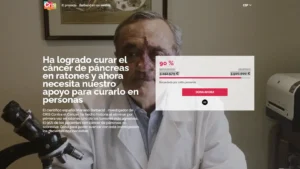
Spanish scientist Mariano Barbacid, a researcher at CRIS Against Cancer and a world leader in molecular oncology, has managed to completely eliminate pancreatic cancer tumors in mice, a historic milestone that could change the future for thousands of patients… if we can successfully translate it to humans.
🩸 3,154,197 of 3,500,000 € DONATED (https://criscancer.org/barbacid/index.html)
A historic breakthrough against one of the deadliest tumors
Ductal pancreatic cancer is especially difficult to treat for several reasons: it is detected late, is highly invasive, and develops resistance extremely quickly.
In most cases, it is driven by mutations in the KRAS gene, present in around 90% of pancreatic tumors.
For years, KRAS was considered an “undruggable” target.
Although drugs targeting this mutation have recently emerged, their effects have been limited and temporary, as the tumor finds alternative survival pathways.
Mariano Barbacid’s team has gone further…
The key: a triple therapy that blocks the tumor’s escape routes
The research, published in one of the world’s most prestigious scientific journals, demonstrates that a combination of three experimental drugs can simultaneously attack the tumor’s critical survival points:
- A direct inhibitor of mutant KRAS
- An inhibitor of EGFR, an alternative tumor activation pathway
- A protein degrader (PROTAC) that removes key factors for cellular resistance
The result is striking 👉 complete and lasting regression of tumors in animal models, with no relapses for months and no significant toxicity.
For the first time, pancreatic cancer cannot escape.
Why is this discovery so important?
Because it breaks one of modern oncology’s biggest barriers:
resistance to targeted treatments.
This approach does not just attack a specific mutation, it closes all possible escape routes for the tumor, something essential in such an aggressive cancer.
The international scientific community has already described this breakthrough as “revolutionary” and “a turning point” in pancreatic cancer research.
But there is a reality that cannot be ignored.
The next step is bringing this therapy to humans
Although the results in mice are extraordinary, it cannot yet be applied to human patients.
Before that, it is essential to complete:
- Advanced safety studies
- Dose and formulation optimization
- Additional preclinical trials
- Preparation for the first clinical trials
All of this requires time, resources, and funding; which is why CRIS Against Cancer has launched an urgent fundraising campaign to start this critical phase.
Fundraising underway: patients need us now
- Total goal: 3,500,000 €
- Raised so far: 3,142,579 €
- Percentage achieved: over 89%
DONATE: https://criscancer.org/barbacid/index.html
Thousands of people have already stepped up to support this research. Every donation brings the real possibility that this treatment will reach hospitals and, in doing so, save human lives.
Supporting this research is not just funding science:
it is giving time, hope, and a future to patients who currently have none.
Supporting Spanish science is supporting life
Spain has top-level scientific talent. What is often missing is the necessary push to bring discoveries from the lab to the patient.
This is one of those key moments.
Science has done its part.
Now society can make the difference.
Pancreatic cancer cannot wait.
Patients need us.
References
Barbacid, M. et al. Combined targeting of KRAS signaling pathways induces durable regression of pancreatic ductal adenocarcinoma in mouse models.
Proceedings of the National Academy of Sciences (PNAS).CRIS Against Cancer Foundation.
Official fundraising campaign for the pancreatic cancer project led by Mariano Barbacid.Mariano Barbacid and the CNIO eliminate pancreatic cancer in animal models. Forbes